
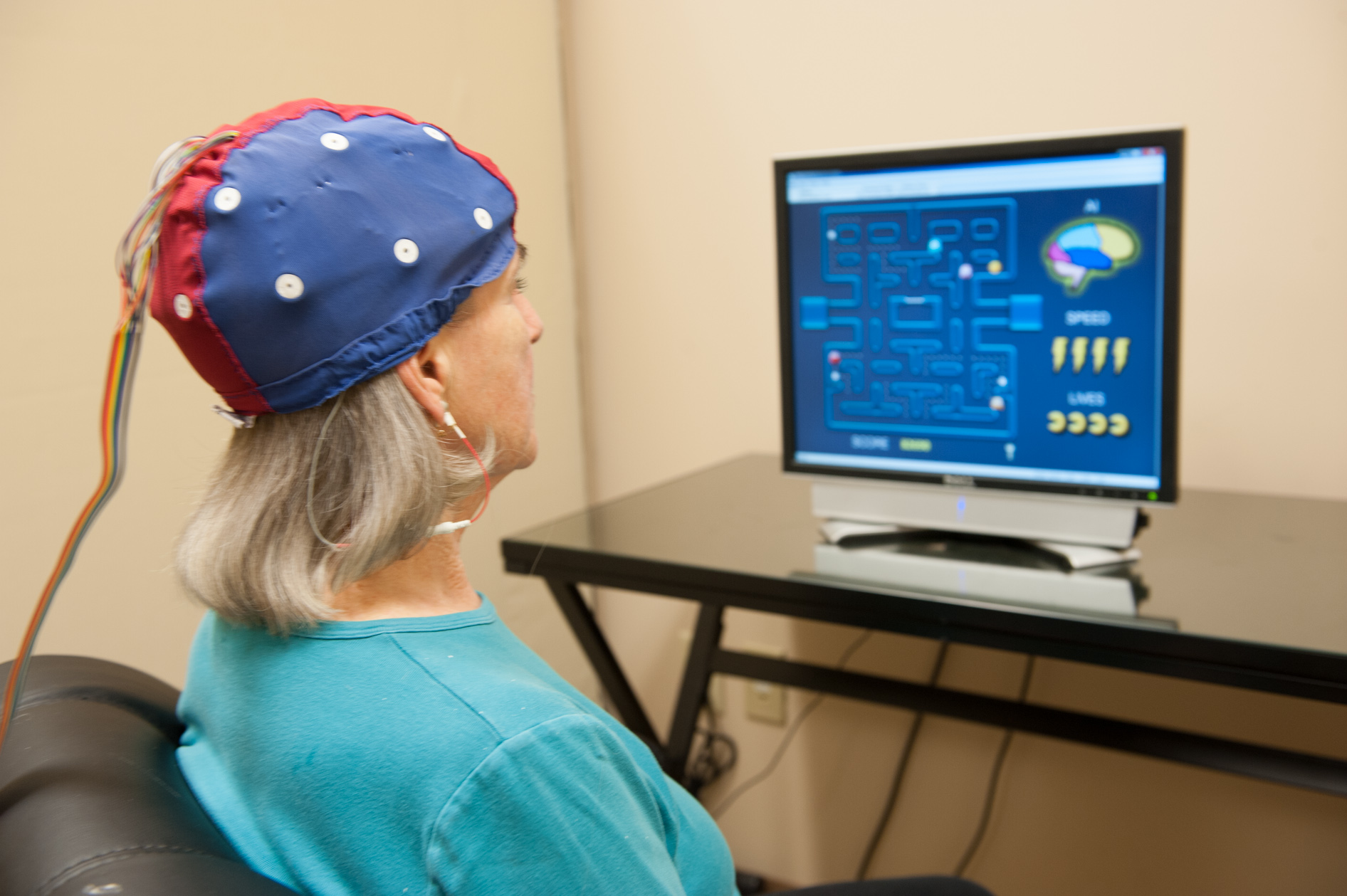
Neurofeedback is the process of training the brain to be more electrically efficient so that it can function at a higher level. Donald Hebb, PhD stated, “Neurons that fire together wire together.” This is the fundamental reality of learning. Anytime we do something repeatedly, we get better at doing it. We can train the brain to be more electrically efficient and higher performing by utilizing this ability of the brain to learn.
Neurons that fire together wire together.
We start by seeking to understand how your brain’s electricity is unique by using advanced diagnostic tool called a quantitatative electroencephalogram (qEEG). This is done by placing what looks like an odd shower cap on the patient’s head. Within this cap are sensors that enable us to measure the internal brainwaves from the surface of the scalp. This is painless, safe, and easy. At this time we often give the patient a challenge such as pressing a button only when they should, and not when they should not. All of this information is recorded, checked for static, and then analyzed via computer to eventually make “Brain Maps.” These maps can be 2D with a series of head images on the page using color to signify if there is too much or too little of any particular wave present. Maps of how fast electricity is flowing thru the brain under different conditions, or maps of the level of chronic stress that is present are made. 3D maps are then created allowing us to see where in the brain the inefficient waveform patterns are coming from.
Because structure and function are so intimately tied together in the brain, knowing where a problem is present, and what kind of problem is present give us options for treatment, using drugs, supplements, dietary changes, neurostimulation or neurofeedback. I contend that there is no such thing as a “normal” brain – each person has uniquenesses and I love to celebrate those uniquenesses – if they are helpful and functional for that person. However, we do know what is average “normal” because we have access to several databases of individuals that have not had seizures, head injury, psychiatric or neurological diagnoses, not on any medications, and with above average intelligence. The average of the brain patterns of these individuals is what we use for comparison when creating an individual patient’s quantitative EEG (qEEG) brain map.
Once we have obtained a qEEG brain map, and understand the electrical patterns present in the brain, and how they may be inhibiting that person’s highest function, we program a computer to assist that person in learning more effective brainwave patterns. This process is called neurofeedback, and it is as safe as learning how to play the piano because that is what is happening – learning.
An EEG cap is placed on the person’s head and our computer watches the brainwaves that are being produced. When the brainwaves that are being produced are of the type, pattern, and amount that are optimal in the part of the brain we are “watching”, that person will receive a reward. If the brainwaves are not what are desired for optimal functioning, the reward is taken away. Most often, the reward that’s given is a movie the patient is watching plays brightly and loudly when the brain is firing in a way we want to reinforce.
When the brain doesn’t do what we want it to, the movie gets dark and quiet. The brain wants the stimulation of the movie, so it figures out the three dimensional neuronal electric combination lock to turn on so that the movie will play more vividly, and because neurons that fire together wire together, new brainwave efficiencies are trained. WOW! From a doctor’s standpoint it is an amazing thing to behold!
What does this look like in the real world? More efficient brainwaves have been shown to improve symptoms of depression and anxiety, to improve attention and working memory speed, to help individuals who have suffered head injuries, and to improve the brain functioning of those individuals with Autism and Asperger’s Disorder.
It is also well documented that EEG Neurofeedback is effective in decreasing the number and frequency of seizures of many different types of seizure disorders, as well as in diminishing migraine frequency and severity. It has also been shown to improve the ability of individuals suffering from addictions to stay in treatment and stay abstinent for longer periods of time. Neurofeedback is safe, very effective, and it has a characteristic of the therapies I most admire. The longer you use it, the less you need it.
If the longer you use a therapy the less you need it, then that therapy is creating true healing and optimizing function. People seeking to maximize their brain performance will utilize EEG Neurofeedback for peak performance training just as individuals who are suffering from brain dysfunction use it to obtain a higher level of normalcy. No matter where you are starting from, better brain function equals a better quality of life.
Getting started is simple. Call or text our Patient Navigators at 615-370-0091. First, you’ll complete a QEEG brain map and CNS Vital Signs test so we can see how your brain is really functioning. Then we’ll build a tailored neurofeedback plan, walk with you through your sessions, and use repeat testing to measure change so you can discover how personalized neurofeedback Nashville care may help you think and feel better.
This blog provides general information and discussions about health and related subjects. The information and other content provided in this blog, website or in any linked materials are not intended and should not be considered, or used as a substitute for, medical advice, diagnosis or treatment. This blog does not constitute the practice of any medical, nursing or other professional health care advice, diagnosis or treatment. We cannot diagnose conditions, provide second opinions or make specific treatment recommendations through this blog or website.
If you or any other person has a medical concern, you should consult with your health care provider or seek other professional medical treatment immediately. Never disregard professional medical advice or delay in seeking it because of something that you have read on this blog, website or in any linked materials. If you are experiencing a medical emergency, please call 911 or call for emergency medical help on the nearest telephone immediately.


