
Myasthenia gravis symptoms are distinctive in one critical way: they are not fixed. Weakness comes and goes, worsens with activity, and improves with rest. A person may feel relatively normal in the morning and struggle to hold their head up or keep their eyes open by late afternoon. That fluctuating pattern is not just frustrating – it is one of the defining features of the disease, and it is often what makes MG difficult to recognize in its early stages.
Understanding the full range of symptoms, how they typically progress, and which signs require emergency attention is an important part of managing this condition effectively.
Early Symptoms of Myasthenia Gravis
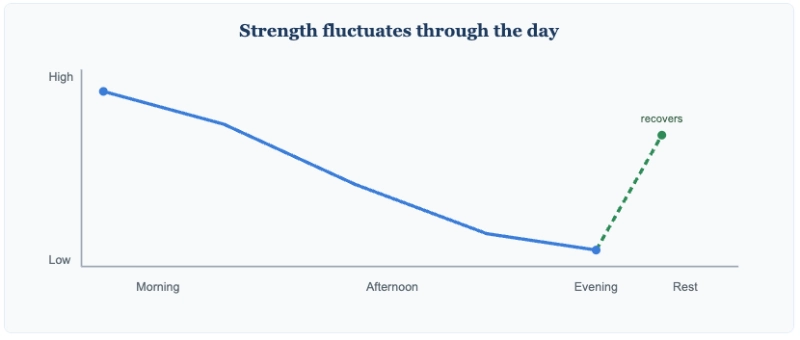
MG weakness characteristically worsens with activity and recovers with rest.
What Are the Most Common Early Signs?
More than 50 percent of patients present with ocular symptoms – drooping eyelids (ptosis) and double vision (diplopia) – as the first signs of MG. These eye symptoms often fluctuate throughout the day, improving after rest and worsening with sustained effort or at the end of the day. Because they can come and go, they are frequently dismissed early on as fatigue, aging, or an unrelated eye problem.
Beyond the eyes, difficulty swallowing, slurred or nasal speech, difficulty chewing, facial, neck, and limb weakness are common as the disease progresses from its early stages.
One of the most important things to understand about early MG symptoms is that the weakness is typically not caused by pain, numbness, or tingling. MG is primarily a disorder of muscle fatigability, not sensation. If numbness, tingling, or significant pain is present, that may point to another or additional condition and should be discussed with a clinician.
Myasthenia Gravis Symptoms in Adults
MG can develop at any age, but the typical onset patterns differ between women and men. Women are more commonly affected in their 20s and 30s, while men tend to develop MG after age 60. In both groups, the earliest symptoms usually involve the eyes – but the rate at which symptoms spread and the muscle groups affected can vary significantly.
Some patients present with eye symptoms first, while others develop early changes in speech, swallowing, neck strength, or limb strength. Age, sex, antibody type, thymus findings, and overall health may all influence how MG appears. These patterns can help guide clinical suspicion, but diagnosis and care planning should be based on the individual patient’s symptoms, exam findings, and test results.
Ocular Myasthenia Gravis Symptoms
Drooping Eyelids (Ptosis)
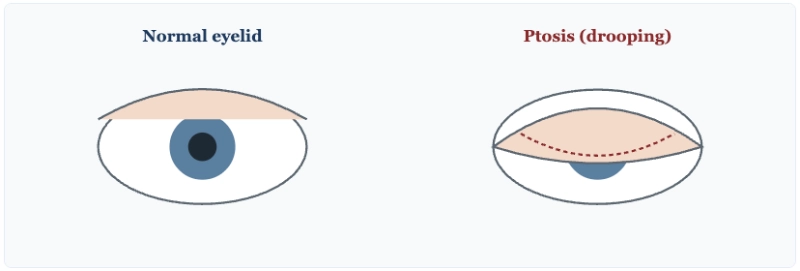
Ptosis: weakness of the muscle that raises the upper eyelid, often variable through the day.
Ptosis is the drooping of one or both upper eyelids due to weakness in the muscle that holds the lid up. In MG, ptosis is characteristically variable – it may be barely noticeable in the morning and severe enough to obstruct vision by evening. It can affect one eye or both, and the degree of drooping may shift from day to day or even hour to hour.
Ptosis in MG is sometimes accompanied by a compensatory lifting of the eyebrows as the person unconsciously tries to keep their vision clear. This is a useful clinical sign and something a neurologist may look for during examinations. During a clinical exam, a neurologist may also look for signs such as the curtain sign, where changes in one eyelid can affect the position of the other. This is one of several bedside findings that may support suspicion for MG.
Double Vision (Diplopia)
Double vision in MG results from weakness in the muscles that coordinate eye movement. When those muscles cannot hold precise alignment between the two eyes, the brain receives mismatched images. The double vision in MG is typically worse when looking in a specific direction, worsens with sustained gaze, and improves after closing one eye or resting.
Like ptosis, diplopia in MG tends to fluctuate. Some patients notice it only when they are tired or after extended screen time. Others experience it throughout most of the day. When diplopia is the only symptom and persists without explanation, MG should be on the differential.
Generalized Myasthenia Gravis Symptoms
Facial and Bulbar Weakness
In generalized MG, weakness extends beyond the eyes to involve the muscles of the face, jaw, throat, and neck. Facial weakness may produce a flat or mask-like expression. The smile may appear more like a snarl. Patients sometimes report that their face feels heavy or that holding a normal expression requires effort.
Bulbar weakness – affecting the muscles used for speaking and swallowing – is one of the more disruptive features of generalized MG. Difficulty swallowing, slurred or nasal speech, and difficulty chewing are characteristic bulbar symptoms. Some patients notice that their voice fades or becomes nasal during prolonged conversation, particularly at the end of a sentence or after speaking for several minutes.
Swallowing and Speech Difficulties
Dysphagia – difficulty swallowing – is reported by a significant portion of MG patients with generalized disease. It can range from mild hesitation with certain textures to frank choking on liquids. Patients may need to rest between bites during meals or shift to a soft diet to manage safely. Choking or coughing while eating is a warning sign that should be brought to a physician’s attention promptly, as it carries a risk of aspiration.
Speech changes in MG are often most noticeable during extended talking. The voice may start clearly but become progressively weaker, more nasal, or harder to project as the conversation continues. This fatigability of speech is considered a hallmark bulbar symptom.
Limb and Breathing Weakness
Proximal limb weakness – weakness affecting the muscles closest to the body’s center, such as the shoulders, hips, and thighs – is common in generalized MG. Patients may have difficulty raising their arms above their head, climbing stairs, or rising from a seated position. Fine motor tasks are less commonly affected than gross motor strength.
Respiratory muscle weakness is the most serious manifestation of generalized MG. Most patients with mild to moderate disease do not notice their breathing is affected under normal circumstances. However, during illness, physical stress, or disease flare, respiratory muscle involvement can progress rapidly and become life-threatening.
Myasthenia Gravis Symptoms in Women vs. Men
While the core symptom profile of MG is similar across patients, age and sex can influence how the disease tends to appear. MG is more common in younger adult women and older men, and some studies suggest differences in symptom patterns and crisis risk across demographic groups. Because these patterns vary, symptoms should always be evaluated based on the individual patient rather than demographics alone.
Men diagnosed after age 60 – a common demographic for late-onset MG – may present with generalized limb weakness and can have a higher association with thymoma in some clinical series. Late-onset MG in older men is sometimes initially attributed to other causes common in that age group, including stroke, Parkinson’s disease, medication effects, or general age-related decline, which can delay correct diagnosis.
What Causes a Myasthenia Gravis Flare-Up?
Even patients with well-controlled MG can experience periods of significantly worsened symptoms. These flares are often triggered by identifiable factors, and recognizing them is an important part of long-term disease management.
The most commonly reported flare triggers include respiratory or other infections, physical overexertion, emotional stress, extreme heat or fever, and disrupted sleep. Surgery and anesthesia can also precipitate significant worsening and require careful pre-operative planning in MG patients.
Certain medications are known to worsen MG symptoms in some patients by interfering with neuromuscular transmission. These may include certain antibiotics, beta blockers, some anesthetic agents, magnesium-containing compounds, and other medications. This does not mean every listed medication is automatically forbidden, but patients with MG should tell all medical and dental providers about their diagnosis and review medication risks with their physician. Patients newly diagnosed with MG should receive and review a complete list of medications that require caution – this is a critical and sometimes overlooked aspect of initial management.
In some cases, a flare has no identifiable cause. The unpredictability of symptom fluctuation is one of the most challenging aspects of living with MG, and it underscores the importance of an ongoing relationship with a treating physician rather than episodic care.
Myasthenia Gravis Crisis: When Symptoms Become an Emergency
Myasthenic Crisis Symptoms
A myasthenic crisis is a medical emergency. It occurs when respiratory muscle weakness becomes severe enough that the patient cannot breathe adequately on their own. Difficult or labored breathing is the main symptom – breathing may feel shallow or as though the muscles are too weak to move air in and out.
According to published neurological literature, between 15 and 20 percent of people with myasthenia gravis experience at least one crisis during their lives, and it most often occurs within the first two years of the disease. In some cases, crisis is the event that leads to the initial MG diagnosis.
Warning signs that a crisis may be developing include rapidly worsening overall weakness, significant difficulty swallowing or managing secretions, shortness of breath at rest, and an inability to speak in full sentences without stopping to breathe. These signs should not be monitored at home.
What to Do During a Crisis
Myasthenic crisis requires immediate emergency medical care. If you or someone with you is experiencing these warning signs, treat it as a medical emergency regardless of whether a diagnosis has been confirmed. Call 911 or go directly to an emergency room. Do not wait to see if symptoms improve. Treatment in the hospital setting may include respiratory support and rapid-acting therapies such as IVIG or plasma exchange, depending on the patient’s condition and the treating medical team’s judgment.
Patients with known MG should inform emergency personnel of their diagnosis immediately. Wearing a medical alert bracelet identifying MG is advisable, particularly for patients with a history of rapid symptom escalation or prior crisis.
Frequently Asked Questions About Myasthenia Gravis Symptoms
What does myasthenia gravis feel like?
MG is usually not experienced as pain or numbness. The primary sensation is often weakness – muscles that tire unusually quickly, tasks that become harder as you continue doing them, and a recovery of strength after rest that makes the pattern feel inconsistent or confusing. Many patients describe difficulty keeping their eyes open, struggling to finish a meal, or noticing their voice fading during a long phone call. The experience varies significantly depending on which muscles are most affected and the extent of the disease. Pain, numbness, or tingling should be discussed with a clinician because those symptoms may suggest another or additional condition.
Can myasthenia gravis cause fatigue?
Yes, though the fatigue of MG is specific. It is fatigable muscle weakness rather than the generalized systemic tiredness associated with conditions like chronic fatigue syndrome or depression. In MG, specific muscle groups become progressively weaker with use and recover with rest. Many patients also report broader fatigue or cognitive fog, especially during flares, poor sleep, medication changes, or periods of high disease burden. These experiences are important to discuss with a clinician, even though MG itself is primarily defined by fatigable muscle weakness rather than direct involvement of the brain.
Are myasthenia gravis symptoms worse at certain times of day?
Yes. Myasthenia Gravis symptoms characteristically worsen throughout the day and improve after rest or sleep. Eye symptoms are often minimal in the morning and most pronounced in the late afternoon and evening. Weakness with speaking, chewing, or swallowing may be most noticeable toward the end of meals. This diurnal pattern is one of the features that distinguishes MG from other neuromuscular conditions and is something neurologists specifically look for when evaluating a potential MG diagnosis.
Can myasthenia gravis symptoms come and go completely?
Yes. Symptom fluctuation is a defining feature of MG, and in some patients symptoms may become minimal or absent for periods of time. This may be described as remission. Remission may be spontaneous or occur in response to treatment. However, the unpredictability of MG means that symptom-free periods do not necessarily indicate the disease has resolved permanently, and ongoing monitoring and management are typically warranted even when a patient is feeling well.
Is myasthenia gravis the only condition that causes these symptoms?
No, and this is part of why MG can be difficult to diagnose. Drooping eyelids, double vision, swallowing difficulty, and muscle weakness can all be caused by other neurological and systemic conditions. Lambert-Eaton myasthenic syndrome, botulism, and certain thyroid disorders can mimic MG. A formal workup including blood tests, nerve studies, and clinical examination is required to confirm the diagnosis. If symptoms suggest MG but initial testing is inconclusive, evaluation by a neuromuscular specialist is warranted.
When Symptoms Point to Something More
Recognizing a pattern of fatigable muscle weakness is an important first step, but symptoms alone cannot confirm MG. A neurologist or neuromuscular specialist may use a clinical examination, antibody testing, and electrodiagnostic studies to determine whether MG or another condition is present. Review the myasthenia gravis diagnosis page to understand the testing process and the myasthenia gravis treatment page for physician-guided management options.
If you have an established diagnosis and want to learn whether MaxWell Clinic’s integrative, physician-guided services may complement your neurological care, call (615) 370-0091 to speak with our team. New or rapidly worsening breathing difficulty, trouble managing secretions, or an inability to speak in full sentences requires emergency care, not a clinic call. Keep this guide available when discussing myasthenia gravis symptoms with your medical team.